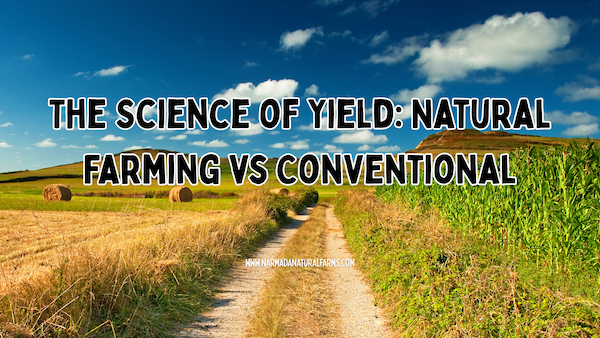
For decades, the debate has been intense: Does natural farming really deliver the same productivity as chemical-heavy agriculture? To answer that, we need to understand the science of yield in natural farming. Yields are not just about the number of kilos per acre. They reflect soil health, crop resilience, input costs, and long-term sustainability. When you put natural farming and conventional farming side by side, science offers a clearer picture than assumptions.
Conventional Farming: High Yields at a Cost
Conventional farming often shows impressive short-term productivity. High-yielding seeds, chemical fertilizers, and pesticides push crops to deliver more in less time. But the hidden cost is soil degradation, groundwater contamination, and rising farmer debt.
Research shows that while yields may rise, the nutritional quality of food often declines. This means we may be producing more in numbers, but not necessarily healthier food.
Natural Farming: A Different Definition of Yield
In natural farming, yield is not just measured in tons per acre. Instead, it focuses on:
-
Soil regeneration – crops perform better as fertility improves season after season.
-
Input savings – natural inputs cost far less than synthetic fertilisers and pesticides.
-
Resilience – crops withstand droughts, pests, or floods better, reducing long-term losses.
This approach shifts the focus from chasing high numbers to securing stable, profitable, and sustainable outcomes.
Also Read: Soil as a Living Organism: Why Healthier Soil = Healthier Profits
Comparing Yields: What the Data Says
Scientific studies indicate that yields in natural farming can be 10–15% lower in the first few years. However, as soil health recovers, yields often stabilise and sometimes even exceed those of conventional systems.
The real benefit shows up in profitability. Input costs drop significantly, soil fertility improves, and market value often rises due to increasing demand for chemical-free produce. This ensures farmers are not just producing, but also earning consistently.
The Science Behind the Difference
-
-
Soil Microbiology – Conventional farming weakens microbial life, while natural farming enhances it. Healthy microbes unlock nutrients more efficiently.
-
Water Retention – Mulching and organic matter improve the soil’s capacity to hold water, lowering irrigation needs.
-
Carbon Sequestration – Natural methods enrich the soil with carbon, improving fertility with every season.
This scientific foundation explains why natural farming yields may seem modest at first but strengthen over time.
-
Also Read: The Hidden Costs of Chemical Farming (That No One Talks About)
Beyond Traditional Yield Measures
Yield should not only be viewed as physical output. Quality, nutrition, soil preservation, and market value are equally important. Natural farming enhances crop taste, texture, and nutrient levels, giving farmers more than just higher volumes — it builds long-term value.
What Farmers Should Expect
If you’re transitioning to natural farming, expect:
-
Initial adaptation – yields may dip slightly in the first year.
-
Soil recovery phase – microbial life, worms, and natural nutrients rebuild in the second and third years.
-
Long-term stability – profits rise as costs fall and yields stabilize.
The science is clear: patience and consistency deliver lasting rewards.
Also Read: From Chemicals to Natural Inputs: What Really Changes on Your Farm
The Bottom Line
When we ask about the science of yield in natural farming, the answer lies in the timeline. Conventional farming wins in the short term, but natural farming proves more sustainable, resilient, and profitable in the long run. Yields are not just about how much you produce, but about how long you can keep producing without exhausting your soil.
Are you ready to explore the science of yield in natural farming for your own land?
Connect with me via WhatsApp for enquiries about webinars and farming consultancy +91 9303539939
📱 Let’s connect on social:
Follow me on Instagram and X (formerly Twitter) for tips, insights, and behind-the-scenes of natural farming. Subscribe to my YouTube channel Natural Farming Made Easy.
Download Rooted In Nature: A practical guide to Natural Farming in India, a comprehensive guide to natural farming, covers essential practices for cultivating a sustainable and productive farm.
Tags: narmada natural farms, natural farming is the future of sustainable agriculture, natural farms, pesticide free, pesticide free farming, sankalp sharma, soil as a living organism, Sustainable Agriculture, the science of yield in natural farming